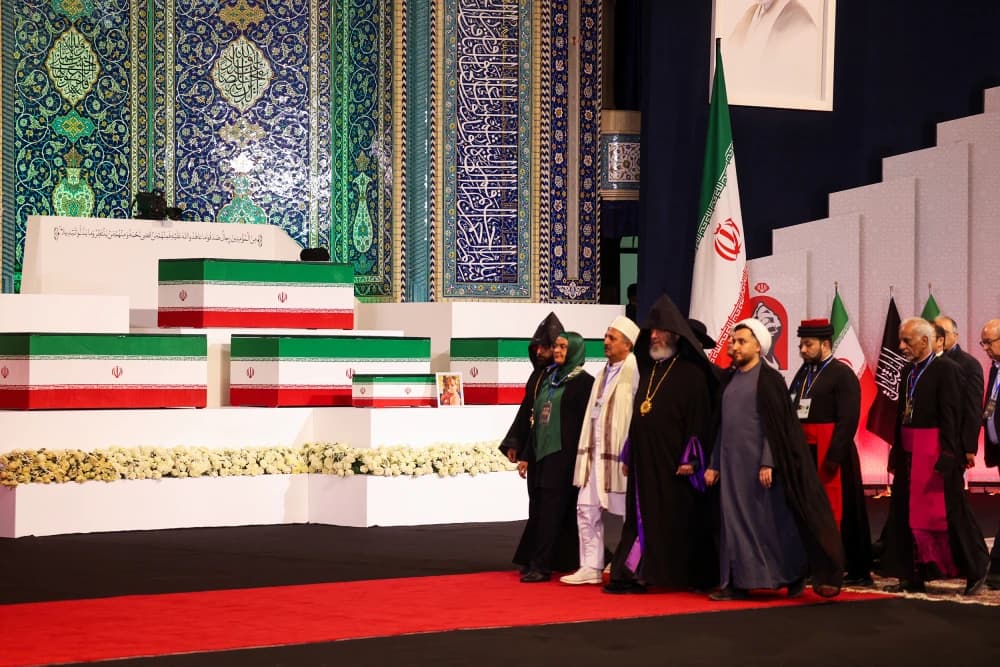
Iran began a sweeping, multi day funeral for Ayatollah Ali Khamenei on Friday, opening a national period of mourning for the supreme leader who governed the Islamic Republic for more than three decades and was killed during this year's war with Israel and the United States. His flag draped coffin was placed before enormous crowds in the capital as the state set in motion the largest funeral it has ever attempted.
Khamenei, who was 86, died on February 28 when a joint American and Israeli air strike hit his residence on the first day of the conflict. Iranian officials say members of his family, including a daughter, a son in law, a daughter in law and a grandchild, were killed in the same attack. The ceremonies had first been planned for early March but were pushed back while the fighting continued and the country steadied itself for a transfer of power.
A capital brought to a halt
Authorities set the opening rites at the Grand Mosalla in Tehran, where mourners dressed in black pressed against barriers to glimpse the coffin. State television described a sea of people stretching far beyond the prayer grounds, and officials estimated that as many as 30 million Iranians would take part across the week, a figure they hope will rival or exceed the 1989 funeral of the republic's founder, Ayatollah Ruhollah Khomeini.
The scale of the preparations underscored the government's intent to turn grief into a display of endurance. Planners said they had readied roughly 50 million loaves of bread, opened thousands of mosques and hundreds of schools to shelter pilgrims arriving from distant provinces, and put a fleet of free vans on the streets to move the crowds. Banners strung along the route carried the official slogan chosen for the occasion, a call to rise, set against imagery tied to the mourning month of Muharram.
Sorrow braided with calls for revenge
The mood in the crowd swung between grief and fury. Mourners chanted against the United States and Israel, and many demanded retaliation for the strike that killed the leader they had followed for a generation. The processions are meant to move from Tehran to the holy city of Qom, then onward, with the final burial planned for the Imam Reza shrine in Mashhad, one of the most revered sites in Shia Islam.
The state wanted the world to see a nation that had lost its leader yet refused to look broken.
A son in the shadows
Conspicuously absent was the man who has inherited Khamenei's title. His son, Mojtaba Khamenei, was elected supreme leader in early March, yet he has stayed out of public view and was not expected to appear at the funeral. Officials pointed to security fears, citing Israeli warnings that he too could be targeted. His absence left the ceremonies without the presence of the country's new paramount figure even as the state worked to project continuity.
Senior figures from the government, the Revolutionary Guards and the clergy joined the opening prayers, standing near the coffin as the crowd surged behind them. For a leadership that spent months absorbing the shock of the war, the choreography of the week is meant to steady both the elite and the public around the succession.
The world sends its envoys
The funeral drew an unusually broad set of foreign delegations, a sign of Iran's web of alliances and the diplomatic stakes that trailed the fighting. Pakistan's Prime Minister Shehbaz Sharif attended, along with President Emomali Rahmon of Tajikistan, Prime Minister Nikol Pashinyan of Armenia and President Mikheil Kavelashvili of Georgia. Senior representatives arrived from Russia, China, Turkey, India, Afghanistan and Bangladesh, and Iranian officials said envoys from more than 100 countries were taking part.
Among those walking past the coffins were representatives of Iran's recognized religious minorities, including Christian, Sunni and other clerics, a tableau the government used to frame the funeral as a moment of national unity. Pakistan, which helped broker the ceasefire that ended the war, has taken a prominent role in the diplomacy since, and the presence of its delegation was read as a marker of that mediation.
A republic in transition
For Iran, the week is as much about the future as the past. The killing of a supreme leader in wartime was without precedent in the republic's history, and the long arc of mourning gives the leadership time to consolidate around Mojtaba Khamenei while rallying a shaken public. Whether the succession holds smoothly, and whether the chants for revenge harden into policy, will shape the country's course long after the crowds in Mashhad have gone home.