When NATO's leaders gathered in The Hague last summer, they made a promise that sounded almost historic. Every member would push military and security spending toward 5 percent of national output by 2035, a leap well beyond the 2 percent benchmark that had taken more than a decade to reach. One year on, the applause has faded and a harder truth is setting in. Making the pledge was the easy part. Finding the money is turning into a struggle that is exposing deep divides across the continent.
The target itself was built to look ambitious yet flexible. It splits into two parts, with at least 3.5 percent of GDP earmarked for core defence such as weapons, troops and readiness, and a further 1.5 percent set aside for a broader idea of security that stretches to cyber defence, infrastructure and the transport corridors armies would need in a crisis. National governments were told to submit road maps by the middle of this year showing how they intend to get there, with a collective stocktake due in 2029 and the final reckoning in 2035.
A widening gap between word and deed
On paper the numbers are moving in the right direction. European defence budgets have climbed from around 218 billion euros in 2021 to roughly 381 billion in 2025, about 2.1 percent of the region's output. Project that trajectory forward and the total could approach 807 billion euros by 2035 if the core target is met. The problem is that the pledges made in front of the cameras are running ahead of the cash that treasuries are actually willing to release.
The split falls roughly along a map of anxiety. Countries closest to Russia are spending as if the threat is immediate, because for them it is. Poland leads the field at about 4.48 percent of GDP, followed by Lithuania at 4 percent, Latvia at 3.73 percent and Estonia at 3.38 percent. For these governments the 5 percent goal is a stretch, but it is not a fantasy.
The reluctant middle and south
Further from the front line the mood cools. Germany, the largest economy, spent about 2.14 percent last year, roughly 95 billion euros, while France sits near 2.25 percent with a 2026 budget of around 68.5 billion euros. Italy and Spain hover close to the old 2 percent floor. Spain has been the loudest sceptic. Its prime minister, Pedro Sánchez, told NATO's secretary general before the summit that a 5 percent target was unreasonable given the country's debt and the cost of pulling money away from schools, health and housing. Madrid secured what amounts to an exemption.
Fiscal reality is the common thread. Italy, Belgium and France have all been placed under the European Union's excessive deficit procedure, which means every extra euro spent on tanks deepens a hole that Brussels is already watching. For heavily indebted states, a sudden surge in military outlays collides with rules designed to keep borrowing in check, and with voters who never signed up for austerity in the name of rearmament.
Announcing a target is a matter of hours. Paying for it is a matter of years, and of budgets that someone always has to defend.
Brussels reaches for the toolbox
The European Union has tried to ease the squeeze. Its ReArm Europe plan aims to unlock as much as 800 billion euros of defence investment by 2029. A central piece, known as SAFE, offers 150 billion euros of joint loans backed by the EU budget, and the first tranches have been steered toward countries including Belgium, Spain, Poland and the Baltic states. A separate escape clause lets governments spend an extra 1.5 percent of GDP on defence without breaching deficit limits, a quiet loosening of rules that were once treated as sacred.
Even so, loans are not the same as spending, and permission to borrow is not the same as the will to do it. Money offered from Brussels still has to be matched by national budgets, absorbed by defence ministries and turned into real orders for equipment that European industry can struggle to deliver at speed.
The politics of guns and butter
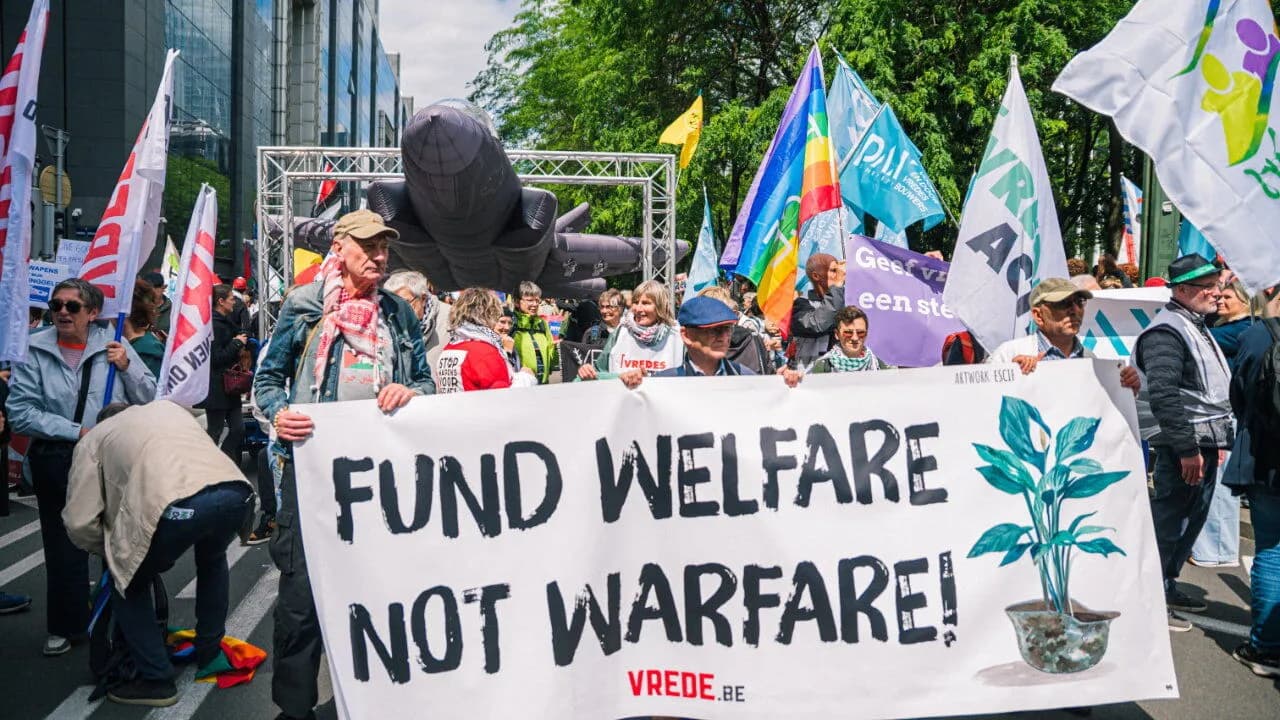
Then there is the public. In Brussels and other capitals, demonstrators have marched under banners demanding welfare rather than warfare, a reminder that every billion moved toward the military is a billion argued over at home. Leaders who promised a new era of strength now face the slower, less glamorous work of writing those promises into law, defending them in parliaments and selling them to citizens who feel the pinch elsewhere.
The coming year will test whether Europe's grand commitment was a turning point or a headline. The road maps are due, the deadlines are fixed and the threat that inspired the pledge has not gone away. What remains uncertain is whether a continent that finds it easy to promise can learn to pay.