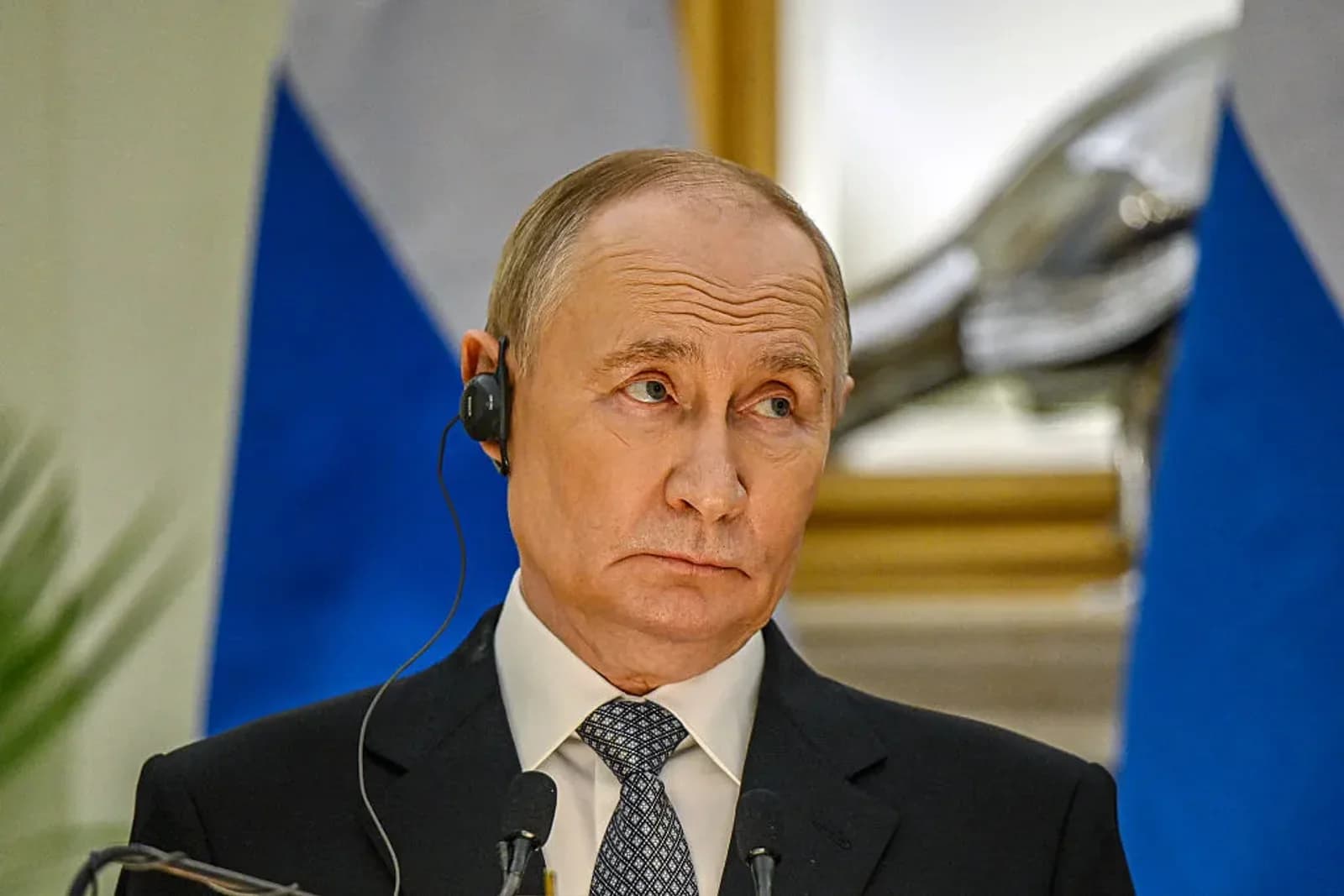
The whole of the Western alliance rests on a single sentence. An attack on one member is an attack on all, and any aggressor who forgets it will find the combined weight of thirty odd nations arrayed against him. For seventy years that promise, written into Article 5 of the NATO treaty, kept the peace in Europe by making the cost of testing it unthinkable. Vladimir Putin has begun, carefully and deliberately, to test it anyway.
He is not doing so with tank columns, at least not yet. The probing is quieter and cleverer than that. Since 2024 Russian drones have drifted into the airspace of a dozen NATO countries, and even neutral Ireland, appearing over airports and military sites before vanishing again. Undersea cables have been cut, railways sabotaged, satellite signals jammed. Each incident on its own is deniable, a malfunction, an accident, the work of unknown hands. Together they form a pattern too consistent to be anything but a campaign.
The purpose of the pinpricks
The point of this harassment is not the damage it does, which is usually modest, but the information it gathers and the fear it spreads. Every drone that crosses a border forces a government to decide whether to shoot it down, scramble jets or say nothing, and every one of those decisions teaches Moscow something about where the alliance is alert and where it is asleep. The incursions map air defences, measure reaction times and test whether NATO's members can coordinate a response or merely trip over one another.
They also work on the mind. A population rattled by mysterious drones and unexplained sabotage grows anxious, and anxious electorates put pressure on governments to avoid provocation, to look away, to hope the trouble passes. That is precisely the reflex Putin wishes to cultivate, because an alliance whose voters have quietly decided that the Baltics are not worth a war is already half defeated before a shot is fired.
The limited attack that could follow
Western intelligence services increasingly fear that the pinpricks are a prelude. American assessments now warn that Putin could, at some point between this autumn and the end of the decade, mount a limited attack on a NATO member, most likely in the Baltics or Poland. The scenario they sketch is not an invasion but something smaller and more insidious, a cyberattack that cripples a city, a brief incursion by unmarked soldiers, a seizure of a sliver of territory, calibrated to fall just below the threshold that would trigger a full allied response.
The aim of such a strike would be political, not territorial. If Russia grabbed a border village in Estonia and NATO hesitated, argued and ultimately did nothing decisive, the alliance's central promise would be exposed as hollow in front of the whole world. The magic of Article 5 lies entirely in the belief that it will be honoured. Puncture that belief once, in even a small way, and every other member starts to wonder whether it too would be left to its fate.
The front line knows
The countries closest to Russia harbour no illusions about what is happening. Poland's prime minister, Donald Tusk, has warned that his country is preparing intensively for a range of scenarios and that the coming months could prove critical. Lithuania, Latvia and Estonia have moved to harden their transport links and energy grids, bracing for the sabotage they assume is coming. These are not distant observers theorising about risk. They are the ones who would be attacked first, and they are behaving accordingly.
Moscow, for its part, plays the innocent. The Kremlin dismisses the warnings as hysteria, with its spokesman waving away one set of Baltic alarms as mere scare stories. The denials are part of the strategy, not a departure from it. Ambiguity is the whole point, because a threat that can always be denied is a threat that western governments can always find a reason to ignore.
The answer the West must give
The uncomfortable truth is that deterrence is not a document but a state of mind, and it has to be renewed constantly or it decays. Putin is probing because he suspects the West is tired, distracted and divided, and unsure whether the Americans will stand behind their European allies as reliably as they once did. Every unanswered drone and unpunished act of sabotage feeds that suspicion, and suspicion, in his calculus, is an opening.
Closing the door he is trying to prise open does not require a war. It requires clarity, the unglamorous work of shooting down the drones, naming the saboteurs, hardening the infrastructure and stating without wobble that a limited attack will be met as an attack on all. The moment to make that plain is now, while the provocations are still small, because the alternative is to leave the question hanging until Putin decides to answer it himself. An alliance that waits to discover whether its promise is real has already begun to lose it.