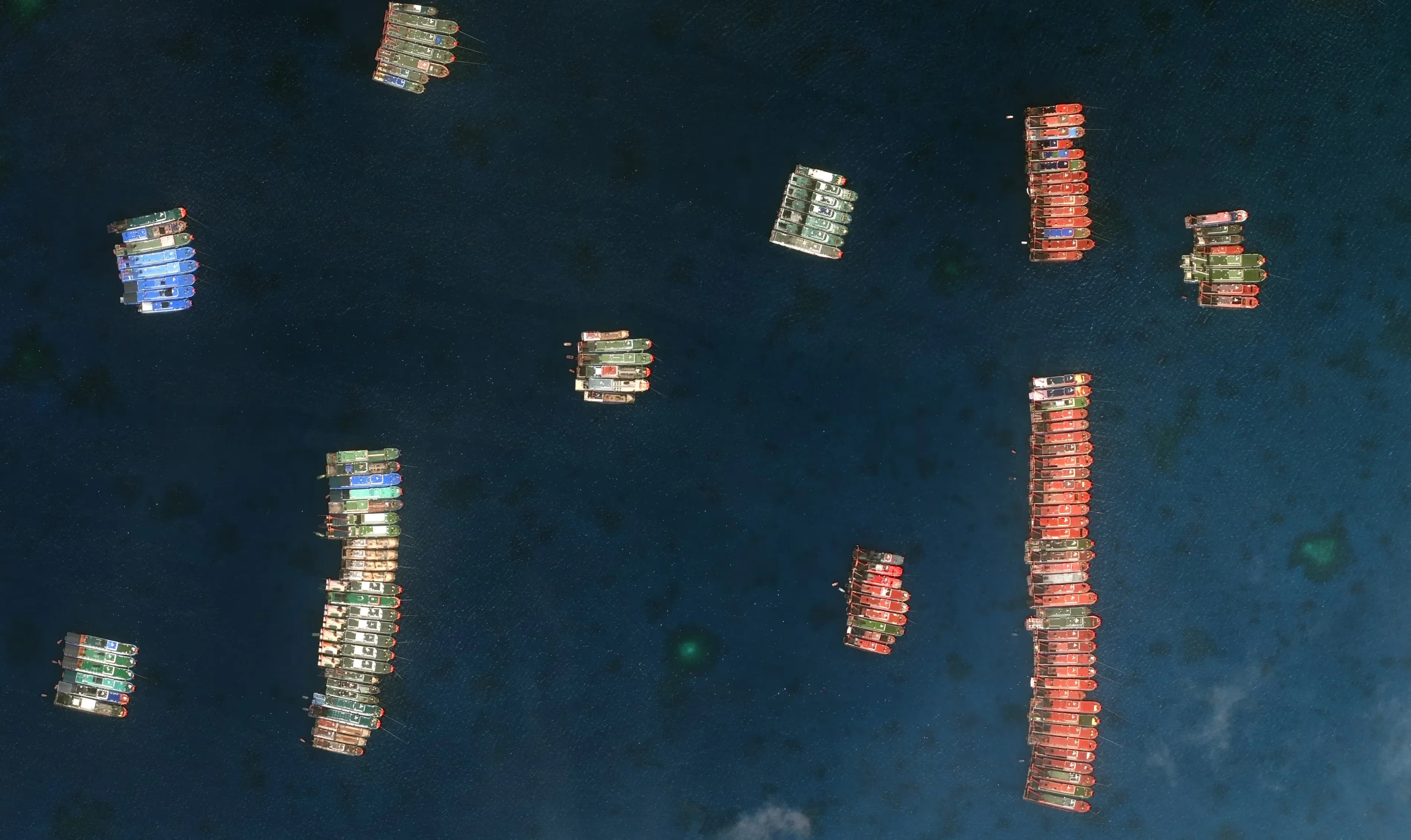
On the satellite images they look like an ordinary fishing fleet, dozens of steel hulled boats clustered together in the turquoise shallows of a distant reef. What gives them away is that they almost never fish. They ride at anchor for weeks, lashed together in tidy rows, their nets dry and their holds empty, waiting for an order that has nothing to do with the sea's harvest. This is China's maritime militia, and it may be the most effective naval force in the world that officially does not exist.
Analysts call the crews the little blue men, a deliberate echo of the little green men who slipped into Crimea in unmarked uniforms before Russia seized the peninsula in 2014. The name captures the trick. These are fighters dressed as civilians, a military capability wearing the costume of a trawler, and their whole purpose is to let Beijing push its claims across the South China Sea while insisting that nothing warlike is happening at all.
A force hidden in plain sight
The formal name is the People's Armed Forces Maritime Militia, and its size is the first thing that unsettles the region's other navies. Estimates run to hundreds of vessels and thousands of crew, a standing fleet that sits under the direct command of the People's Liberation Army even as it flies no flag of war. The boats are often larger and sturdier than genuine fishing craft, some purpose built with reinforced hulls and water cannon, ready to shoulder rival ships aside without a shot.
Beijing's answer to all of this is to shrug. Chinese officials do not acknowledge that the militia exists as a fighting force, referring instead to a so called maritime militia and treating the vessels as private fishermen going about their business. That deniability is not a weakness in the plan. It is the plan. A trawler cannot start a war, and a country that only ever sends trawlers can always claim the other side is the aggressor.
Winning in the gray zone
What the militia does is operate in what strategists call the gray zone, the wide band of coercion that sits above ordinary diplomacy and below open combat. The boats swarm. They arrive in overwhelming numbers at a reef or a shoal and simply occupy the water, crowding out fishermen from the Philippines or Vietnam, blocking supply runs, and parking themselves on features China wants to control. No torpedoes are fired. The territory changes hands anyway.
They also serve as the eyes and logistics tail of the larger fleet, feeding surveillance back to the coast guard and the navy that usually hover just over the horizon. The three tiers work as one, the militia in front as plausible civilians, the coast guard behind them with heavier ships, and the navy further back as the unspoken threat. An opponent who pushes through the fishing boats finds himself escalating against the Chinese state, which is exactly the choice Beijing wants to force on him.
The genius of the tactic is that every response looks like an overreaction, so the victim is left choosing between humiliation and a war he cannot win alone.
Scarborough and the reef that will not rest
The pattern has a history. In 2012 a standoff at Scarborough Shoal, a rich fishing ground west of the Philippines, ended with Chinese vessels, militia among them, taking effective control of the lagoon and never leaving. Manila took the dispute to an international tribunal, and in 2016 the court ruled decisively that China's sweeping claim to most of the sea had no basis in law. Beijing dismissed the ruling and carried on. The paper victory changed nothing on the water.
Since then the flashpoint has shifted to Second Thomas Shoal, where the Philippines keeps a tiny garrison aboard a rusting warship it deliberately grounded in 1999 to anchor its claim. Resupplying those marines has become a recurring drama, with militia and coast guard vessels ramming, blocking and blasting the Filipino boats with water cannon. Footage of blue hulled trawlers boxing in a small supply craft has become one of the defining images of the confrontation, proof that fishermen who never fish are doing the work of a blockade.
Why a boat matters more than a battleship
It is tempting to dismiss all of this as harassment, a nuisance rather than a threat. That underrates how much the militia has already achieved. Reef by reef, season by season, Beijing has normalised its presence across waters that three neighbours also claim, and it has done so without giving anyone a clean reason to fight back. The South China Sea carries a third of global shipping and sits atop vast fisheries and suspected energy reserves. Control of it, even creeping and unofficial control, reshapes the balance of power across Asia.
For the countries on the receiving end, and for the United States that has treaty obligations to the Philippines, the militia poses a genuinely hard problem. Sink a fishing boat and you are the one who opened fire on civilians. Ignore it and you concede the water. That dilemma is the whole point, and until someone finds a convincing answer to it, the blue hulled fleet will keep sitting at anchor over the reefs, catching nothing and winning everything.