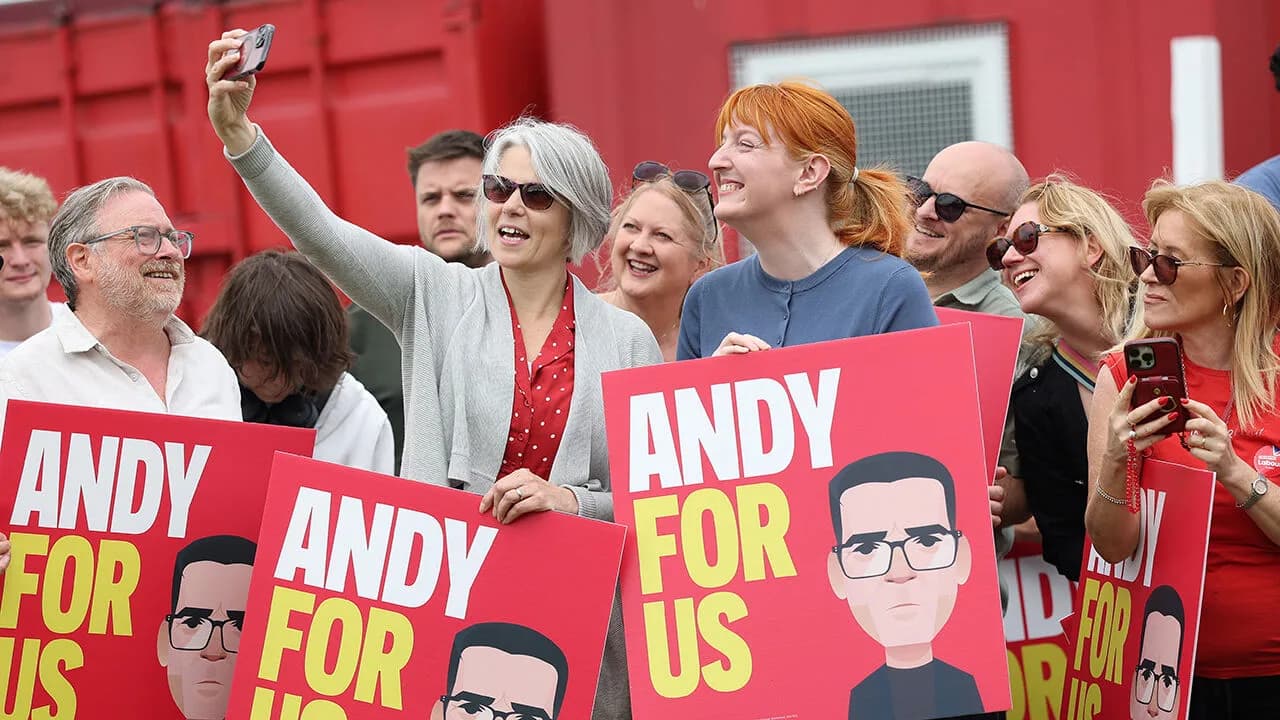
Andy Burnham walked into Downing Street this week as the answer to a question his party had spent a year refusing to ask out loud. Could Labour survive Keir Starmer? The verdict, delivered without a general election and without a rival on the ballot, was that it could not. Burnham arrives as Britain's seventh prime minister in ten years, and the first in a long while to reach the job carrying real hope rather than mere relief.
The hope is not baseless. Where Starmer had become a byword for caution that curdled into drift, Burnham brings a different register, warmer, more combative, rooted in a place rather than a committee room. Whether that is enough to reverse a decline this deep is the question that will define his premiership, and the early signs suggest he has weeks, not months, to prove it.
How the ground gave way
Starmer's fall was slow and then sudden. Two years after a landslide that gave Labour one of the largest majorities in its history, the party had managed to convert a mandate into a mood of exhaustion. A run of policy reversals, a series of avoidable scandals and an economy that refused to lift the national spirits combined into something close to contempt. The local elections in May were the breaking point, with Labour shedding more than a thousand council seats in a single night, a result no amount of spin could soften.
By June the pressure inside the parliamentary party had become impossible to contain, and Starmer agreed to step down. What followed was less a contest than a coronation. Burnham secured nominations from 379 of Labour's 403 members of parliament and ran unopposed, a show of unity that also revealed how frightened the party had become. He was declared leader on July 17 and took office as the departing prime minister formally resigned.
The man from Greater Manchester
Burnham is not new to the top of British politics, only to its very summit. He spent sixteen years as a member of parliament and held cabinet posts under both Tony Blair and Gordon Brown before twice failing to win the Labour leadership. Rather than fade, he left Westminster altogether in 2017 to become mayor of Greater Manchester, a decision that looked at the time like a retreat and now looks like the smartest move of his career.
In Manchester he built a brand that Westminster could not touch, part regional champion, part folk hero, the man who fought the last government over lockdown support and won a reputation as a straight talker in a trade not known for it. He returns to national politics promising to govern the way he governed the city, by handing power outward. Give it to the place you live, he has said of the essentials of daily life, framing decentralisation not as an administrative reform but as a moral one.
A party that has forgotten how to sound like the country it governs has just handed the microphone to the one figure who still knows the tune.