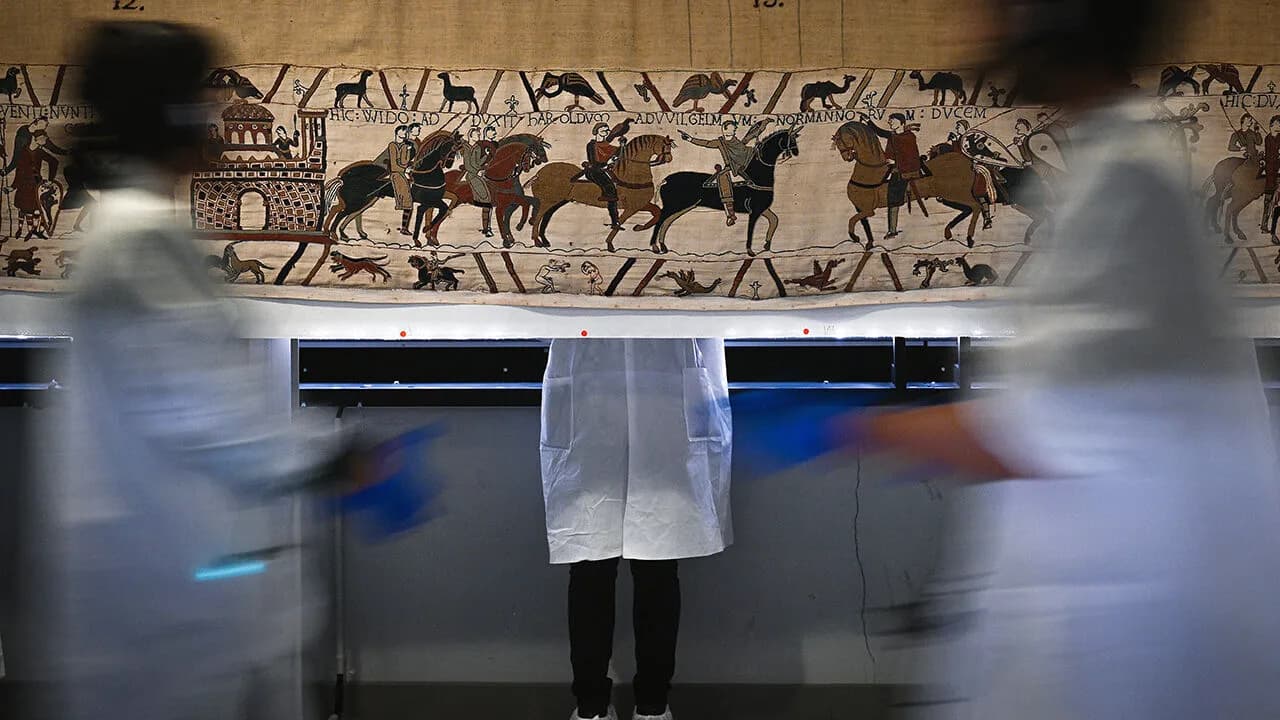
There is a temptation, whenever a great work of art moves, to reach for a number. What is it insured for? What would it fetch at auction? With the Bayeux Tapestry, now arriving in England for the first time in almost a thousand years, the question is close to meaningless. There is nothing to compare it with, no second example that might set a price, and no owner willing to sell. Its worth lies somewhere the market cannot reach.
The object itself is deceptively plain. It is not a tapestry at all in the strict sense but an embroidery, wool thread stitched into a strip of linen roughly seventy metres long. Across that length it tells a single story, the conquest of England in 1066 by William, Duke of Normandy, and the defeat of the Saxon king Harold. In fifty eight scenes it packs in more than six hundred human figures, around two hundred horses, ships, castles, feasts and battles, a whole world unspooling from left to right like a strip of film made nine centuries before film existed.
A witness, not a treasure
The reason it matters is that almost nothing else from its age survives in this form. Chronicles and charters record what kings did. The tapestry shows how people lived. Look closely and you find the shape of a Norman helmet, the rigging of a ship built in the Viking tradition, the way a meal was served, the tools a carpenter used. It is history told not by a distant summary but by someone who seems to have known the texture of the moment. That is a kind of evidence money cannot buy, because it cannot be made again.
It is also, of course, propaganda. The tapestry tells the winners' version, casting Harold as an oath breaker who brought his fate upon himself and William as the wronged party restoring order. Yet even its bias is valuable, because it preserves how the victors wanted to be remembered. Few pieces of political spin have lasted a thousand years, and fewer still are beautiful.
Made in England, kept in France
There is a quiet irony in this homecoming. The embroidery is thought to have been made in England, probably by English hands, not long after the conquest it describes. For most of its life, though, it has lived in Normandy, in the town of Bayeux that gave it its name. So its arrival at the British Museum is less a visit than a return, the first time the work has been on English soil since it was created. For a nation that has studied it in classrooms for generations without ever seeing it, that is no small thing.
The loan runs from September 2026 to July 2027, and it did not come easily. It was announced during a state visit to Britain by President Emmanuel Macron in the summer of 2025, the culmination of years of careful diplomacy between two countries whose histories have been tangled together since the very events the tapestry depicts. The timing suits both sides, coinciding with a renovation of the museum in Bayeux that normally holds it.