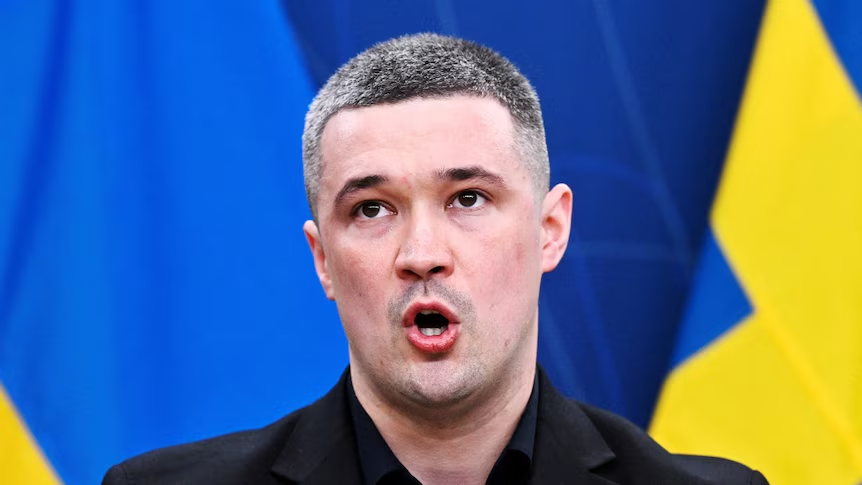
A former senior Ukrainian official has broken his silence on the corruption scandal that has convulsed Kyiv's wartime government, telling the BBC that President Volodymyr Zelensky himself should be pressed on what he knew and when. Mykhailo Fedorov, who was removed from his post as part of a broader government shake-up, spoke to BBC World in an interview that lands at a delicate moment for Ukraine's leadership, as the country tries to balance a grinding war effort with mounting public frustration over graft in state institutions.
Fedorov, who had built a public profile as one of the architects of Ukraine's digital transformation and wartime tech initiatives, did not mince words when discussing accountability at the top of government. According to the BBC, he suggested that scrutiny should not stop with the officials already implicated or dismissed, but should extend directly to the president's own knowledge of the wrongdoing that has been uncovered.
The remarks are notable because they come from an insider rather than an opposition figure or outside critic. Fedorov's career had been closely associated with Zelensky's political project since the president's rise to power, making his willingness to publicly call for the president to be questioned a significant break from the unified front the government has generally tried to present during the war.
Corruption has long been a sensitive fault line in Ukrainian politics, predating the full scale invasion by Russia in 2022. Successive governments have pledged reform as a condition of continued Western financial and military support, with international partners repeatedly tying aid packages to progress on anti graft measures and judicial independence. Any suggestion that corruption has reached deep into the current administration threatens to complicate those relationships at a time when Ukraine remains heavily reliant on foreign backing to sustain its defense.
The scandal that led to Fedorov's dismissal and those of other officials has reportedly touched sensitive areas of state spending, feeding public anger in a country where ordinary citizens have endured years of hardship, blackouts and personal sacrifice tied to the war. For many Ukrainians, revelations of graft within government ranks strike a particularly raw nerve given the scale of loss experienced on the front lines and the austerity forced on households by the conflict.
Beyond the corruption allegations, Fedorov used the interview to raise a separate and politically charged issue: the question of elections. Ukraine has not held a presidential or parliamentary vote since the imposition of martial law following Russia's invasion, a legal mechanism that suspends elections during active conflict. Zelensky's original presidential mandate technically expired in 2024, a point Kremlin officials and some critics abroad have seized on to question his legitimacy, even though Ukrainian and most Western legal experts maintain that the wartime suspension is constitutionally sound.