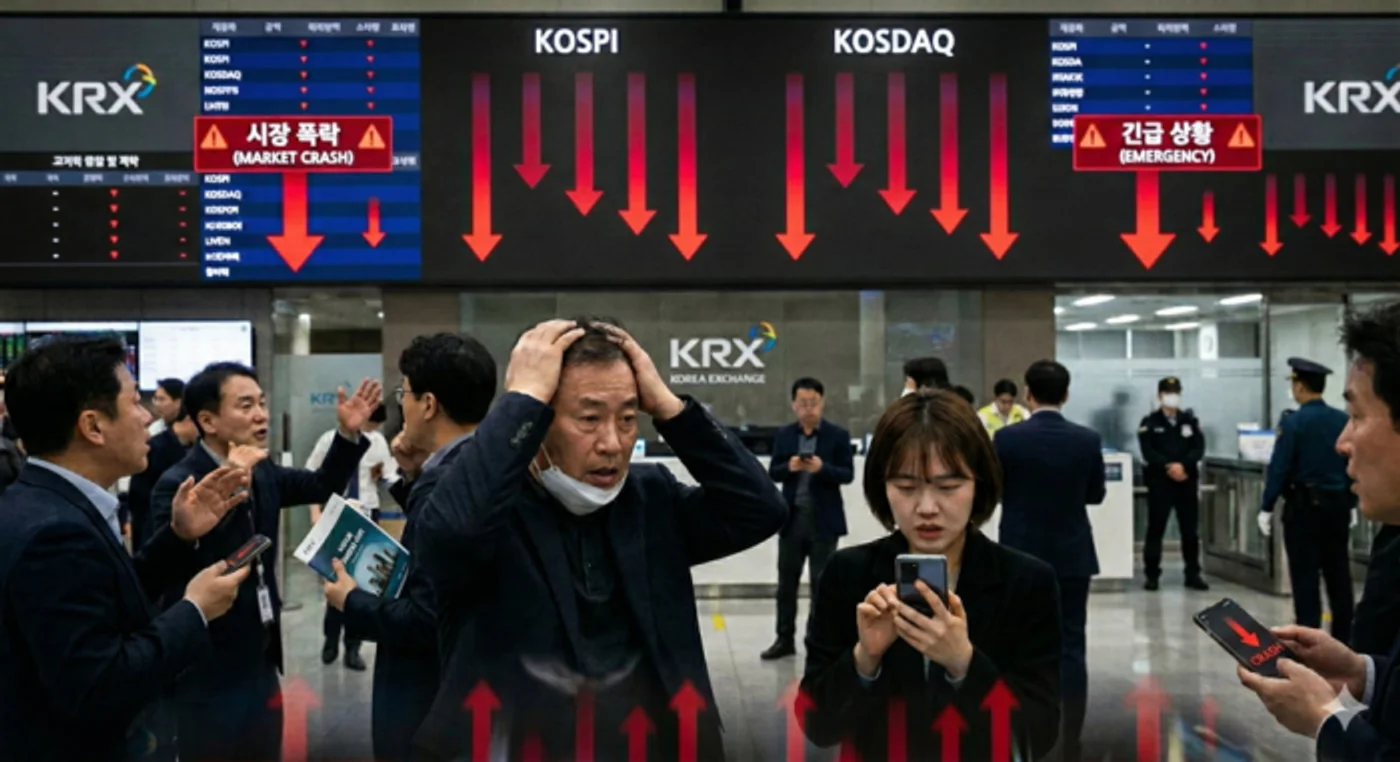
For more than a year, South Korea had the most exciting stock market on earth. Money poured in, prices only seemed to travel in one direction, and a country long dismissed by investors as perennially cheap suddenly looked like the great growth story of the age. Then, in the space of a few weeks, the whole edifice came down. What had been the envy of global markets is now the site of one of the fastest collapses in modern financial history.
The scale of the preceding boom explains the violence of the bust. From the spring of last year to its peak in June, the benchmark KOSPI index surged by close to 300 percent, its strongest run since the legendary bull market of the 1980s. At its height the index touched a record above 9,385, and for a brief, giddy moment South Korea ranked as the sixth largest equity market in the world. Investors spoke of a mad bull, and for a while the label felt like a boast rather than a warning.
Built on borrowed money
Underneath the rally sat a structure that looked sturdy only while prices rose. This was a boom powered less by pension funds and foreign institutions than by ordinary Koreans, millions of whom threw themselves into the market with a fervour that unsettled even the optimists. They did not simply buy shares. They bought leverage, borrowing to amplify their bets and crowding into risky products that magnified the swings of individual stocks.
The favourite vehicles were single stock exchange traded funds tied to the country's two chip champions, Samsung Electronics and SK Hynix, the companies whose memory chips sit at the heart of the artificial intelligence boom. By early July the value of outstanding leveraged positions had swelled to a record 29.2 trillion won, close to 20 billion dollars. It was a wager, repeated a million times over, that Korea's grip on the world's most important technology was unbreakable and that the only direction left was up.
A blow from Beijing
The unbreakable assumption broke on July 28. Word arrived that China had begun mass producing its own deep ultraviolet machines, the intricate tools used to etch advanced chips, a capability that had until then belonged to a tiny club of foreign suppliers. For a market whose entire thesis rested on Korean dominance of the chip supply chain, the news landed like a hammer. If Beijing could build the machines itself, the moat that justified so many of those leveraged bets suddenly looked a great deal shallower.
The selling that followed was ferocious and self feeding. As prices fell, the borrowed money that had lifted the market went into reverse. Brokerages issued margin calls, forced sales begat lower prices, and lower prices begat still more forced sales. Around 2.3 trillion won of positions were liquidated by force in a matter of weeks, each sale adding to the downward spiral. The same leverage that had made the ascent so intoxicating now made the descent almost impossible to stop.
Worse than the old disasters
The numbers now being compared are the ones Koreans least want to hear. The index has shed more than 40 percent in roughly 40 days. To put that in perspective, the crash of 2008 took about a year to carve out a decline of 57 percent. This time the drawdown has approached 44 percent from the June record in a fraction of that time, making it, by the brutal measure of speed, worse than either the Asian financial crisis of 1997 or the global meltdown of 2008. Something on the order of 2.5 quadrillion won of paper wealth has evaporated since the peak.
For the households at the centre of it, the losses are not abstract. A generation of small investors who were told that the market was a patriotic bet on their nation's future, and who borrowed heavily to make it, have watched their savings and their loans vanish together. The political temperature has risen accordingly, and the government has been drawn into emergency measures to try to arrest the slide and calm a furious public.
A fragile floor
There are the first tentative signs of a floor. The index bounced by more than 4 percent in a single session late in the week, helped by record quarterly earnings from Samsung Electronics and by bargain hunters wading in after a punishing two day slump of nearly 16 percent. Whether that marks a genuine bottom or merely a pause in a longer decline is the question now consuming Seoul, and nobody can answer it with confidence.
What is already clear is the lesson. South Korea's boom was real, built on genuine strengths in the technologies that will define the coming decade, but it was inflated by borrowed money and a story that admitted no doubt. Markets that rise on leverage and certainty tend to fall on the same. The country's underlying industrial prowess has not vanished in a month, yet the belief that it could never be challenged has, and rebuilding that confidence will take far longer than it took to destroy.