No company has profited from the artificial intelligence boom quite like Nvidia. It supplies the specialised chips on which almost every advanced AI model is trained, it has ridden that position to a valuation once thought impossible for a maker of semiconductors, and its founder has become one of the most recognisable executives on the planet. Yet the most interesting question in technology right now is not how far Nvidia has climbed. It is whether the very customers who carried it up there are about to become the rivals who drag it back down.
The scale of its dominance is still extraordinary. Nvidia commands something in the region of three quarters of the market for AI accelerators, and by some measures far more of the narrower business of training the largest models. For years its chips have been so essential, and so scarce, that buyers queued for the privilege of paying premium prices. That kind of pricing power is the sort most companies only dream about, and it has made Nvidia the reference point against which every rival is measured.
Why the software matters more than the silicon
The foundation of that lead is not really the hardware. It is a piece of software called CUDA, the programming layer that lets developers harness Nvidia's chips, and which an entire generation of AI engineers has grown up using. Millions of them are fluent in it, and every model, tool and shortcut built on top of it deepens the dependence. Nvidia's true moat is not that its chips are fast, though they are. It is that the people who build AI are locked in by their own code, and rewriting that code to run on someone else's silicon is expensive, slow and risky.
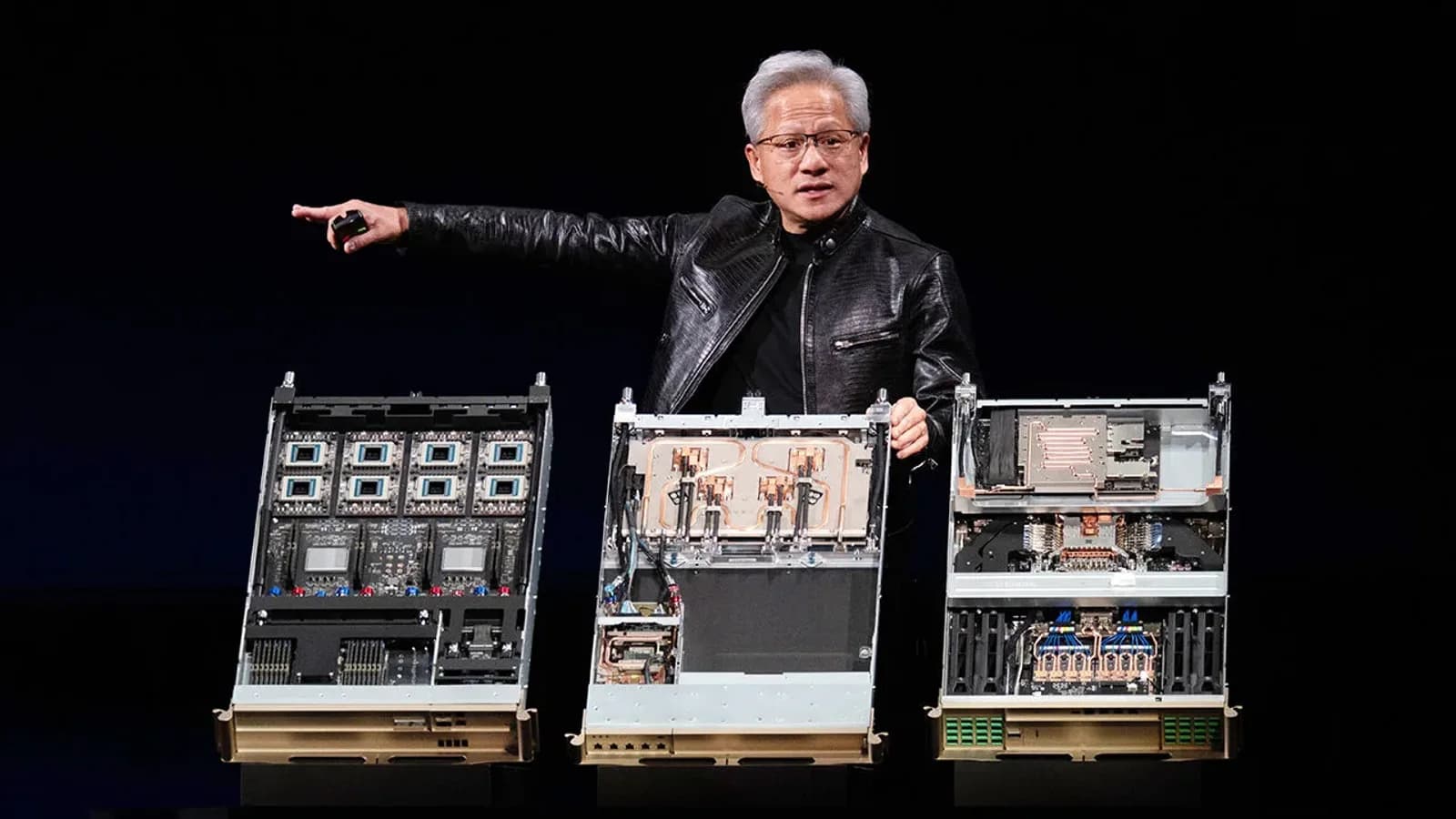
The company works hard to keep it that way. It no longer sells mere chips but entire systems, bundling processors, networking and memory into integrated platforms, and it refreshes them at a punishing annual cadence. Its next generation, the Vera Rubin platform due late this year, folds a custom processor and graphics chip together with the newest high bandwidth memory and promises a large leap in performance for every watt of power consumed. The strategy is to run so fast that no challenger can ever quite catch up.
The customers strike back
The challengers, however, are no longer scrappy start ups. They are the biggest and richest companies in the world, the cloud giants that have been Nvidia's largest customers, and they have grown tired of paying its prices. Google has its Tensor Processing Units, now in their eighth generation and split into versions tuned for training and for the lighter work of running models. Amazon has Trainium, Microsoft has Maia and Meta has its own line of accelerators. Each is designed to do a narrower set of jobs than an Nvidia chip, but to do them more cheaply and in tighter harmony with the company's own data centres.
Behind much of this effort stands a quieter beneficiary. Broadcom has become the essential partner for firms that want to design their own silicon without building a chip business from scratch, and it now accounts for the lion's share of the custom accelerator market, having helped create Google's chips and Meta's among others. Marvell plays a similar role for others again. The result is that a hyperscaler no longer needs Nvidia's expertise to field a credible chip of its own, which removes one of the last practical barriers to going it alone.
The battle moves to inference
The ground on which this fight will be decided is shifting. For years the prize was training, the enormously expensive process of building a model in the first place, and there Nvidia reigned supreme. But as AI moves from the laboratory into everyday products, the greater cost is increasingly inference, the humbler task of actually running those models billions of times a day for real users. Inference rewards efficiency and predictability over raw power, and that is precisely the sort of work a custom chip, purpose built for one company's needs, can do at lower cost.
The numbers attached to the shift are striking. Custom silicon, which accounted for only a sliver of the market a couple of years ago, could soon handle a meaningful share of both inference and training, and some analysts think Nvidia's grip on the inference business in particular could loosen sharply over the next few years. The pattern favouring ever more capable general purpose processors is also bending toward workloads that reward specialisation, giving rivals such as AMD a fresh opening alongside the in house designs.
Still the one to beat
None of this means the throne is about to fall. Nvidia will almost certainly remain the dominant supplier of AI chips for years, because the software lock in is real, the pace of its releases is relentless, and no single custom chip can match the breadth of what it offers. A hyperscaler building its own silicon is not trying to replace Nvidia entirely, only to shift enough of its own workloads in house to blunt the bills and regain some leverage. That is a more modest goal, and a far more achievable one.
What is ending is not Nvidia's leadership but its era of unchallenged pricing power, the stretch in which it could sell everything it made at almost any price to buyers with nowhere else to turn. As those buyers build alternatives, the balance tilts, and even a company as commanding as Nvidia must now win its customers rather than simply ration them. The silicon showdown will not produce a single victor. It will produce something the AI industry has not had until now, which is genuine competition, and that alone marks the end of Nvidia's easiest years.